
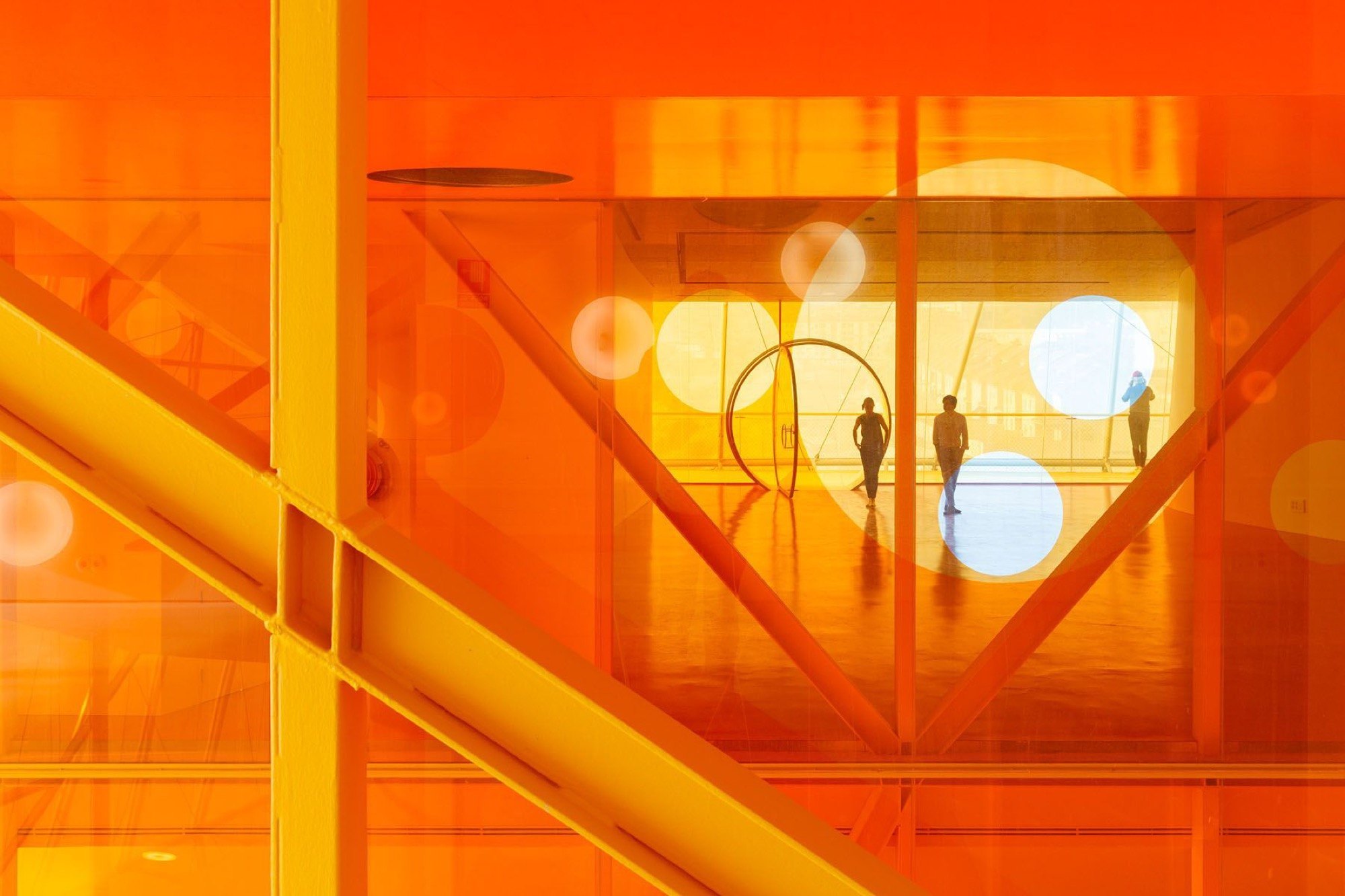

We first came across SelgasCano in 2015. Before that, they had been off our radar. Lucía Cano and José Selgas founded the Madrid-based architecture office in 1998. In February 2023 we had the chance to interview José Selgas, and the conversation gave us a closer look at the way they practise architecture.


An effortlessly creative website
Well, I think our website is a reflection of our work and our office. We have always been a small office. At some point we could have grown, but we never did, and we just decided to keep it that way. Lucía and I are partners in life and in work, so we decided we wanted to be part of the whole process of architecture, from the very beginning to the last touch on the construction site. It is fundamental for us to control the amount of work we have in the office. We don’t do what we think we don’t need. And I guess that is also related to the website.
We used to have a very complex one. It was a lot of work, with a lot of humour, but it was difficult, and we had no one to take care of it. There are only architects in our office. So at one point we decided our website would simply be Google. In the end, more or less all of our work is on Google. Just search "selgascano" and you will see everything. It has probably been more than ten years like that, and it is still the same. We never touch it.


SelgasCano has always kept its modesty
There are only architects in our office, and they focus on the work of the office, on the architecture. Everyone is in the same position, everyone does everything. Physically we have seven people here and three more in other places. We move continuously from one thing to another. Someone can work on a small detail of something big or small, or start a project from the beginning. At some point it is a little bit of chaos. But we like that too. We quite enjoy the feeling that we are never balanced. It works well for us.
After we finished the Serpentine Pavilion in England in 2015, we received many invitations to lecture from universities and institutions. The number of calls was insane, all asking SelgasCano to give a lecture, and we simply said no to all of them. Of course we could say yes, but it is impossible. Lecturing takes a lot of time, even though we love doing it. You need to prepare the presentation, then you need to travel and so on. It can take something like a week. I mean, we lose or we gain. We love travelling and meeting people. We always say no to online things, to samples, to lectures, because we want to be there in the place. That is fundamental to us.
We see our profession the same way. Sometimes clients tell us they want us to come up with an idea or a concept, and then their own people or local architects will develop it. We say no.
We want to be involved from the beginning to the very end. For us it is like creating a recipe that we want to cook, and we are more the cooks than anything else. That part of the work is much more interesting and enjoyable.


Nature is an indispensable part of SelgasCano
Their office and home sit on a site surrounded by nature.
The first time our office went public, the photos were taken by Iwan Baan, a close friend of ours. It is about fifteen minutes’ drive from the centre of Madrid. All over the world, people are used to real woods with wild animals, so when they see our office they say, "Oh my God, it must be scary, no? What do you do if a snake comes in?" Well, there are no snakes here. It looks like a wood, but it is simply a place surrounded by landscape.
You are always here with nature. You see the different moments of the day. You feel the rain perfectly, the heat of the sun, the movement of the weather, the seasons. In summer it is very hot and dry here, but we have no air conditioning in the office, and everyone sweats. We have to open both sides of the office to let air through and bring the temperature down. That way we get to feel the environment.
Julio Cano Lasso was Lucía’s father, a very lovely man. He had a great passion for nature, for plants, for everything. Lucía has that passion too, probably from him. She knows more about plants than perhaps anyone I have ever met, and she teaches me a lot about them. I have always had that passion as well. So our relationship with nature has been very important. I think it matters in architecture because it is there everywhere, from the beginning.
"I am not your boss"
At SelgasCano, Lucía and I have exactly the same role. We fight a lot, but we also agree on many things. Everyone in our office is open to the others and we share everything. Most of them have been with us for a long time. I guess they are happy, otherwise they would have moved somewhere else. They know us and we know them, so working together is very easy. They understand immediately, exchange opinions and give ideas.
When a project gets to the point where it looks finished, or about to be finished, we change the concept, because we don’t think it is enough for the whole project. I think they are used to it. They know it is going to happen again and again. Sometimes it comes more from them, sometimes from us. But of course I am not going to say "I am the boss" or "you need a boss". It is very relaxed, because they are easy to work with. We have a lot of respect for the people working with us. It is more that they have the same quality, the same ideas. In many respects they know much more than we do. It is a continuous collaboration. There isn’t really a fixed role in the office. You can say and do more or less whatever you want. In the end, it is a matter of getting to know someone over time.


Light structures and a free spirit, on a budget
I think lightness is something we understood many years ago. It is related to energy. Mass and energy are linked by a straight formula. The more mass you use, the more energy you need to make it and transport it to the site. Lightness matters for the planet because it needs less energy to produce, transport and install. Lightness is also related to economy: less energy means a lower price. We rarely have clients with an endless budget. They have very small budgets and we have to deal with that. So we have learned the cheapest materials, the ones we generally use, and we are happy with them.
Concrete is an expensive material, and it is the usual one in construction. Part of our walls are concrete, and the timber boards used for the formwork were then recycled as our ceiling beams. We use concrete where the building touches the ground and the water, because concrete is easier to deal with there. The rest of the wall is built from other materials, and here we mostly use wood for the structure.
We are comfortable with any material. We are happy with wood, steel, plastic or glass, whatever we need, depending on the project and the location. In the end, economy is probably the most important thing for the client, because they have to pay for it. We have a joke with many clients that we are actually the clients and they are the architects. Sometimes clients arrive with ideas and we say, "Sorry, that’s too expensive, we don’t have the money for that." We try to lower the budget and still ensure the quality, because we know that is what matters in the end.
At the moment we are working on projects in other parts of the world, with many limitations of labour and material. The project in China, for example, is very complicated because they are so used to concrete. Or in the US, wood is the main thing, but any wood you want to use seems too expensive right now, and you have to use it very carefully. So it depends a lot on where you are working and what you have around you.


Using salvaged materials
We sometimes try to use salvaged materials, like recycling the timber formwork from the concrete as ceiling beams. Even when recycling is possible, it is not an easy task. Sometimes it costs more than buying new materials.
The Serpentine Pavilion was sold after it was shown in London. After the buyer paid, they decided to move it to the LACMA garden, an art museum in Los Angeles. We wanted to keep all the materials after dismantling it and send everything to the US, of course. But keeping all the ETFE takes a lot. Moving it would cost 70,000 pounds, and the price they got straight from the factory for new material was 30,000 pounds. Obviously the client went for the cheaper option. To reuse materials, you have to dismantle the thing, employ a lot of people to pack it properly and so on. And I can’t understand why the price is so different.


Using salvaged materials is not your decision alone. Most people who work this way usually have what they need at hand. We are doing some work in the countryside, which makes us very happy, because you can get raw material right next door or from the street. Everything depends on the situation, and for us salvaged material is a complicated thing.
"For us, the people who use the place in the end are very important"
How a city looks is very much about community. Public buildings are built to serve their citizens and others. For us, the people who use the place in the end are very important. You can’t know all of them, of course, unless it is a house, an office or an auditorium, but you can more or less decide what you are playing with. I usually put myself in the place of the client when designing a space. When you have a feeling for a particular space, then you know what qualities you should give it. You need to go to that place and feel at home, feel comfortable in many ways being there. If you are happy and enjoying it, people will probably feel the same.
When we worked with Second Home, an organisation that provides co-working space, they came to my house and office and said they wanted us to create something similar to what we have here. People would probably appreciate a workspace that feels like home. In response, we ended up involved in everything, from design to building and even choosing the furniture.


The future of architecture is renovating and reusing
I think the architecture of the future will be more about reusing what we have already built. At Second Home, for instance, most of the projects reuse old buildings, and we are happy to do that. We now have other places like that, and for us it is fantastic. Here in Spain there is plenty of opportunity, and I guess elsewhere in the world too, there are many abandoned houses. People in the cities complain about how expensive a house is and so on. We want to go to the countryside, take a house or an old factory or whatever, and renovate it. It makes more sense than creating something from scratch. When people ask us for a renovation, we are very happy to do it. Usually we don’t need to start from the beginning, and that is fine. This is the future of architecture.
Colour is a material
To us, colour is a flexible material. The beam in my house, for example, I painted orange, and the rest of the place is white. We use colour when we need to. About 90% of the colour across all SelgasCano projects is white, and the other 10% comes from the palette. On the floor you can’t use white or black because of dust and dirt, unless you are using concrete or rubber or another material. At that point you need to choose a colour.
Orange is very good for floors. People feel safe walking on it without worrying about leaving footprints or dirt. And when light falls on orange, it gives the whole room a feeling of cosiness and warmth. We don’t use much green inside buildings because it looks artificial, but of course you can use it in some cases. I think in the end we have used almost every colour. We try everything, especially white.


Interview by Phạm Hà Thu, February 2023. Edited by Trần Hiếu Anh Nguyên. Photos by Iwan Baan.